

How to Check Oil
Quick Answer: To check oil, park on level ground, wait 5 to 10 minutes after switching off the engine, then pull out the dipstick, wipe it clean, push it back in fully, and pull it out again. The oil level should sit between the MIN and MAX marks. If it is at or below MIN, add oil right away.
Why Checking Your Oil Matters
To check oil, park on level ground, wait 5 to 10 minutes after switching off the engine, then pull out the dipstick, wipe it clean, push it back in fully, and pull it out again. The oil level should sit between the MIN and MAX marks, and if it is at or below MIN, add oil right away. Checking matters because engine oil coats the moving metal parts so they slide instead of grinding, carries heat away from the engine, and keeps dirt in suspension until the oil filter catches it.
If the oil level drops too low, the parts inside the engine start to rub metal on metal. That causes wear that cannot be undone, and in the worst case the engine seizes and stops completely. A new engine can cost thousands of dollars. A five-minute oil check can prevent that.
Low oil can also turn on the check engine light. Modern engines use oil pressure to control parts of the valve timing system, so when the oil is low, the computer stores a fault. If your check engine light is on, checking the oil is one of the first steps. See our guide on what does check engine light mean for the full list of causes.
Checking your oil is one of the easiest car jobs there is. You need no tools, and it takes less than five minutes. Every driver should know how to do it.
What You Need
You need almost nothing to check your oil.
- A clean rag or paper towel: to wipe the dipstick.
- Your owner's manual: to find the dipstick location and the oil grade your car takes.
- Gloves (optional): to keep your hands clean.
- A funnel and a quart of the right oil (optional): only if you plan to top up the oil.
That is it. No jack, no tools, no lift. You do this standing next to the car with the hood open.
How to Check Oil: 7 Steps
Follow these steps in order. The whole job takes about five minutes.
- Park on level ground. If the car is on a slope, the oil will pool to one side and the reading will be wrong. A flat driveway or a parking lot works fine.
- Switch off the engine and wait 5 to 10 minutes. The oil needs time to drain back down into the oil pan. If you check right after driving, the level will read low. Never check the oil with the engine running.
- Open the hood and find the dipstick. The dipstick has a bright handle, usually yellow, orange, or red. It sticks out of the engine block. If you are not sure which one it is, check the owner's manual. Do not confuse it with the transmission dipstick, which is a different part. For more on that, see our guide on how to check transmission fluid.
- Pull the dipstick out and wipe it clean. Pull it all the way out and wipe the oil off with your rag or paper towel. This first pull is not the reading. It just cleans the stick so you get a true reading next time.
- Push the dipstick back in fully. Slide it all the way back into the tube until the handle seats. If it is not fully in, the reading will be wrong.
- Pull it out again and read the level. Hold the dipstick flat and look at where the oil line sits. Compare it to the marks on the stick.
- Put the dipstick back and close the hood. Push it fully back in. If the level was fine, you are done.
Safety note: Keep your hands and loose clothing away from the cooling fans. On many cars, the fans can start on their own even after the engine is off. Also, be careful around hot engine parts. If you just drove the car, the engine is hot. Wait the full 10 minutes before you reach in.
How to Read a Dipstick
How to Read the Dipstick
Dipsticks look different from car to car, but they all use the same idea. There are two marks, and the oil level should sit between them.
| Dipstick Mark | What It Means |
|---|---|
| Two pinholes | Oil should sit between the two holes |
| L and H | L is low, H is high. Oil should sit between them |
| MIN and MAX | Oil should sit between MIN and MAX |
| Crosshatched area | Oil should sit inside the crosshatched zone |
Here is how to read the result:
- Between the marks: The level is fine. You do not need to add oil.
- Near the top mark: The level is good. No action needed.
- Halfway between the marks: The level is okay, but you can add a little if you like. It is not urgent.
- At or below the low mark: Add oil now. Do not drive far with the level at or below MIN.
- No oil on the dipstick at all: This is serious. Do not start the engine. Add oil right away, or call for help. If the engine has been running with no oil showing, it may already be damaged. Get it to a mechanic.
The difference between the low and high marks is about 1 quart on most cars. That means if the level is at the low mark, adding about 1 quart will bring it to the high mark. Add a little at a time and recheck, as explained below.
What the Oil Color Means
Oil color tells you something about the condition of the oil, but it does not tell you everything. Here is what to look for.
| Oil Color | What It Means | What to Do |
|---|---|---|
| Golden or amber | Fresh oil, like new | Nothing. This is normal for new oil. |
| Brown or dark brown | Used oil, still doing its job | Normal. Dark oil is not bad oil. |
| Black | Old oil, or oil that has been in the engine a long time | Change the oil if it is due. |
| Milky, creamy, or foamy | Coolant is leaking into the engine | Stop driving. Tow the car to a mechanic. |
| Oil with metal particles | Metal flakes in the oil | Internal engine damage. Get to a mechanic now. |
| Oil that smells like fuel | Fuel is getting into the oil | Get the car checked soon. The level may also be rising. |
A common mistake is to think that dark oil means bad oil. Oil turns dark quickly because it picks up dirt and soot. That is its job. Dark brown or black oil can still protect the engine well. Color alone does not tell you when to change the oil. Follow the mileage and time interval in your owner's manual instead.
Milky oil is different. If the oil on the dipstick looks like a chocolate milkshake, coolant is mixing with the oil. This usually means a blown head gasket or a cracked engine part. Do not drive the car. Have it towed to a shop.
How to Add Engine Oil
If the level is at or below the low mark, add oil. Here is how.
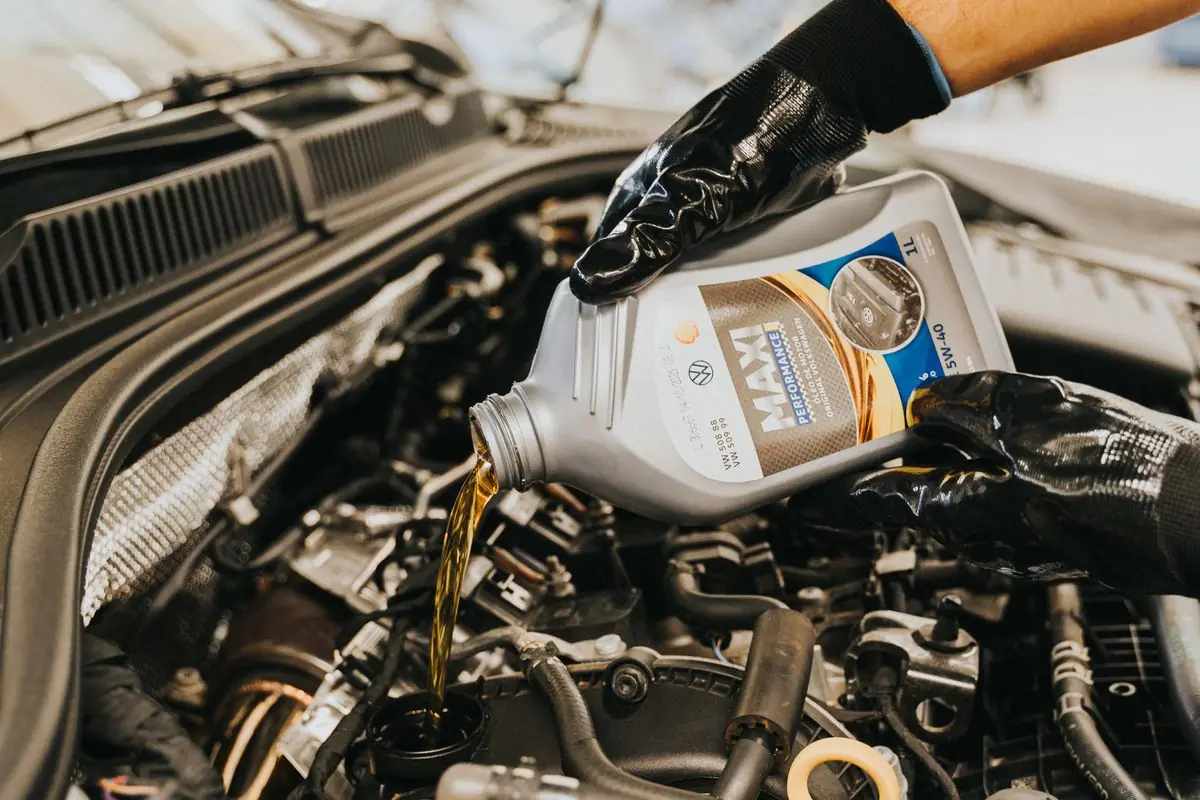
- Buy the right oil. Check your owner's manual for the grade, like 0W-20 or 5W-30. Buy oil by the quart. Look for the API or ILSAC certification on the bottle, and the Dexos label if your car is a GM.
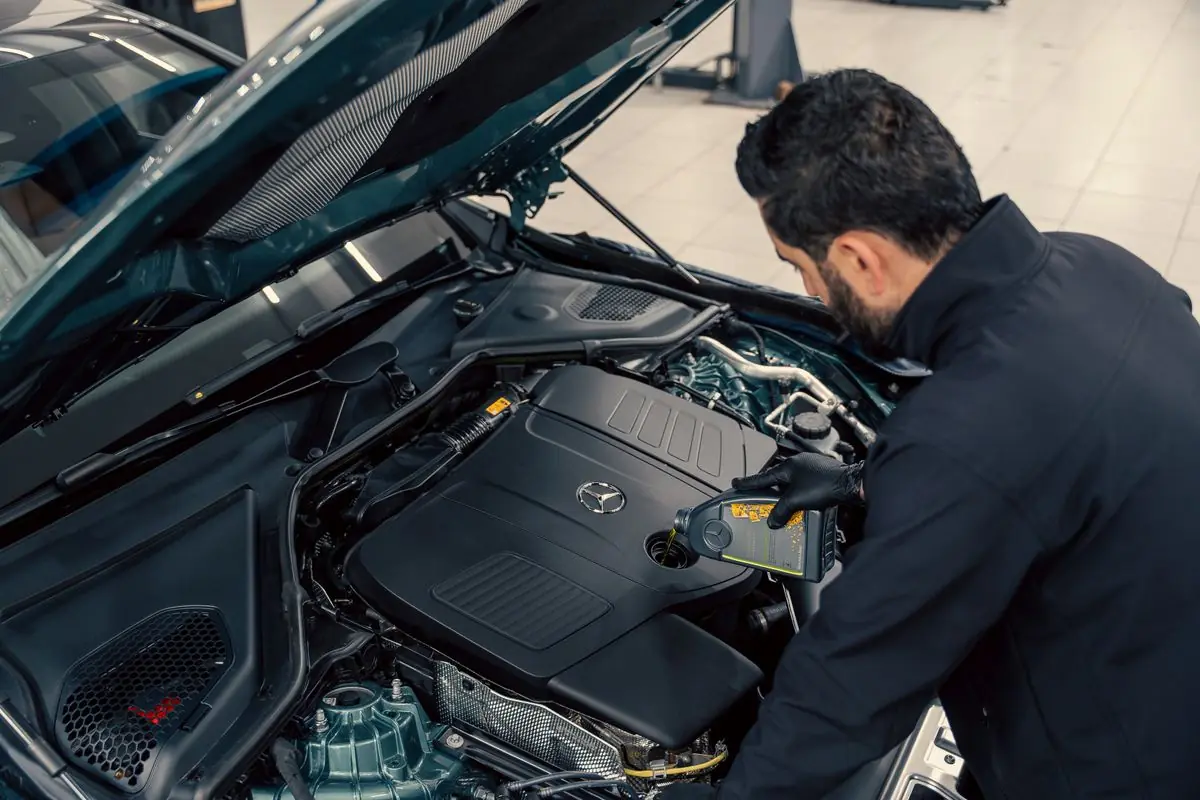
- Find the oil filler cap. It is on top of the engine and has an oil can symbol on it. Unscrew it.
- Put a funnel in the filler hole. This stops spills. Oil on the engine can smoke and smell bad when the engine heats up.
- Add about half a quart at a time. Pour slowly. Then wait about a minute for the oil to drain down.
- Recheck the level. Pull the dipstick, wipe it, push it back in, and pull it out again. Repeat until the level is between the marks.
- Stop at or just below the MAX mark. Do not overfill. Overfilling causes the oil to foam, and foaming means the oil cannot protect the engine properly. Overfilling can also cause leaks and can damage the catalytic converter over time.
Most cars rarely need more than 1 quart between oil changes. If you are adding oil often, the engine may be leaking or burning oil. Check for oil spots under the car, and see the section below on normal oil burning.
What Oil Does Your Car Take?
Your owner's manual tells you the exact oil your car needs. The grade looks like a code, for example 0W-20 or 5W-30. Here is what the numbers mean in plain English.
- The first number with the W stands for winter. It tells you how the oil flows when the engine is cold. A lower number flows better in cold weather. 0W flows better than 5W on a cold morning.
- The second number tells you how thick the oil is when the engine is hot. A higher number is thicker at operating temperature. 30 is thicker than 20.
- Use the grade in your manual. Do not guess. Using the wrong grade can hurt fuel economy and engine wear. Many modern cars use 0W-20 because it is thinner and saves fuel. Older cars often use 5W-30.
You can also check the oil filler cap. Many cars have the grade printed right on the cap.
Cars With No Dipstick: Electronic Oil Level
More new cars have no dipstick at all. Instead, they have an electronic oil level sensor and a display on the dashboard or the infotainment screen. This is common on many BMW, Mercedes-Benz, Audi, and newer GM models.
Here is how to check the oil on a car with no dipstick.
- Park on level ground and switch off the engine.
- Wait 5 to 10 minutes for the oil to settle.
- Turn the ignition on without starting the engine, or start the car and let it idle, depending on the model. Your owner's manual tells you which.
- Go to the vehicle settings or service menu on the dashboard display.
- Find the oil level reading. It will show a bar or a message like "Oil level OK" or "Add 1 quart."
- Follow the message. If it says to add oil, add it through the filler cap the same way as a normal car.
The electronic system is convenient, but it is slower than a dipstick. It takes a few minutes to give a reading, and it may not work if the car is on a slope or if the engine is too hot or too cold. If the system gives an error, check the owner's manual or ask a mechanic.
How Much Oil Burning Is Normal?
Some engines burn a little oil as they run. This is normal, up to a point.
- Up to 1 quart per 1,000 to 2,000 miles can be normal on some engines, especially high-mileage engines and some performance engines.
- More than 1 quart per 1,000 miles is too much. Get the engine checked.
- Blue smoke from the exhaust means the engine is burning oil. A little puff on startup can be normal on an older car. Constant blue smoke means worn piston rings or valve seals.
- Oil spots under the car mean a leak. Common leak points are the oil drain plug, the oil filter, the valve cover gasket, and the oil pan gasket.
If you are adding oil every few hundred miles, do not just keep topping it up. Find the cause. A mechanic can check for leaks and do a compression test to see if the engine is worn inside.
Troubleshooting: What If Something Looks Wrong?
- Dipstick shows no oil at all: Do not start the engine. Add 1 quart, wait a minute, and check again. If it still shows nothing, add another quart and check again. If the engine has been driven with no oil, get it to a mechanic.
- Oil level is rising: The level should never go up on its own. A rising level means fuel or coolant is getting into the oil. This is often a fuel injector problem or a head gasket problem. Get it checked.
- Oil smells like fuel: A strong fuel smell in the oil can mean a leaking fuel injector or too many short trips where the engine never fully warms up. If the smell is strong, get the car checked.
- Overfilled by mistake: If you added too much oil, you need to remove some. The easiest way is to use a fluid pump through the dipstick tube, or have a shop drain a little from the oil pan. Do not drive with the oil far above the MAX mark.
How Often Should You Check Oil?
Consumer Reports says to check your oil at every other gas fill-up. Ford says to check it every time you fill up. Either way, the habit is simple: check it often.
- Every other fill-up: a good habit for most drivers.
- Before a long road trip: always check before you drive far.
- Once a month at least: even if you do not drive much. Oil gets old whether you drive or not. Consumer Reports notes that oil lasts about 6 months before it needs changing, even if the car sits in the garage.
- If your car is older or uses oil: check every time you fill up.
An oil change is usually due every 5,000 to 10,000 miles or every 6 to 12 months, depending on your car and the oil type. Your owner's manual gives the exact interval. Do not rely on the oil color alone to decide when to change it.
Frequently Asked Questions
How often should I check my engine oil?
Check it at every other gas fill-up, or at least once a month. Check it before any long trip. If your car is older or burns oil, check it every time you fill up.
What happens if I run out of oil?
The engine parts rub metal on metal, which causes wear that cannot be undone. The engine can overheat and seize. This is one of the most expensive repairs a car can have. A five-minute oil check prevents it.
Can I check the oil when the engine is hot?
Yes, but wait 5 to 10 minutes after switching off so the oil drains back into the pan. Never check with the engine running. Be careful around hot parts, and keep your hands away from the cooling fans.
What is the difference between 0W-20 and 5W-30 oil?
The first number tells you how the oil flows when cold. 0W flows better than 5W in cold weather. The second number tells you how thick the oil is when hot. 30 is thicker than 20. Always use the grade in your owner's manual.
How much oil do I add if the level is low?
Add about half a quart at a time, wait a minute, and recheck. The gap between MIN and MAX is about 1 quart on most cars. Stop at or just below the MAX mark. Do not overfill.
My car has no dipstick. How do I check the oil?
Use the electronic oil level display on the dashboard or infotainment screen. Park on level ground, wait 5 to 10 minutes, then follow the menu to the oil level reading. Your owner's manual gives the exact steps for your model.
Reviewed by the AutoFixr Editorial Team. Every fact in this guide was checked against manufacturer service information and Consumer Reports guidance. Oil grades and intervals vary by vehicle. Always follow your owner's manual.